I used to spend my entire Sunday curled up on the couch watching mindless television, yet I would wake up on Monday morning feeling even more depleted than before, which taught me that active vs. passive rest is a distinction we must master for true recovery. For years, I equated “rest” with “stagnation.” I thought that if I wasn’t moving, I was healing. However, my journey through chronic stress and the resources at Heal showed me that sometimes, the body needs more than just a nap; it needs a change in frequency. At Heal, we focus on restoring inner harmony through sound and thought, acknowledging that your nervous system requires different types of “input” to actually downshift from the high-alert state of modern life.
Learning to identify which type of rest my soul was actually craving saved me from the cycle of perpetual burnout. We often feel guilty for resting because we choose the wrong kind, leading to “rest resistance.” When you understand how to navigate the spectrum of recovery, you stop viewing rest as a luxury and start seeing it as a vital biological necessity. This exploration is about more than just sleep—it’s about the integration of mind and body to achieve a state of genuine peace.

Defining Passive Rest: The Art of Doing Nothing
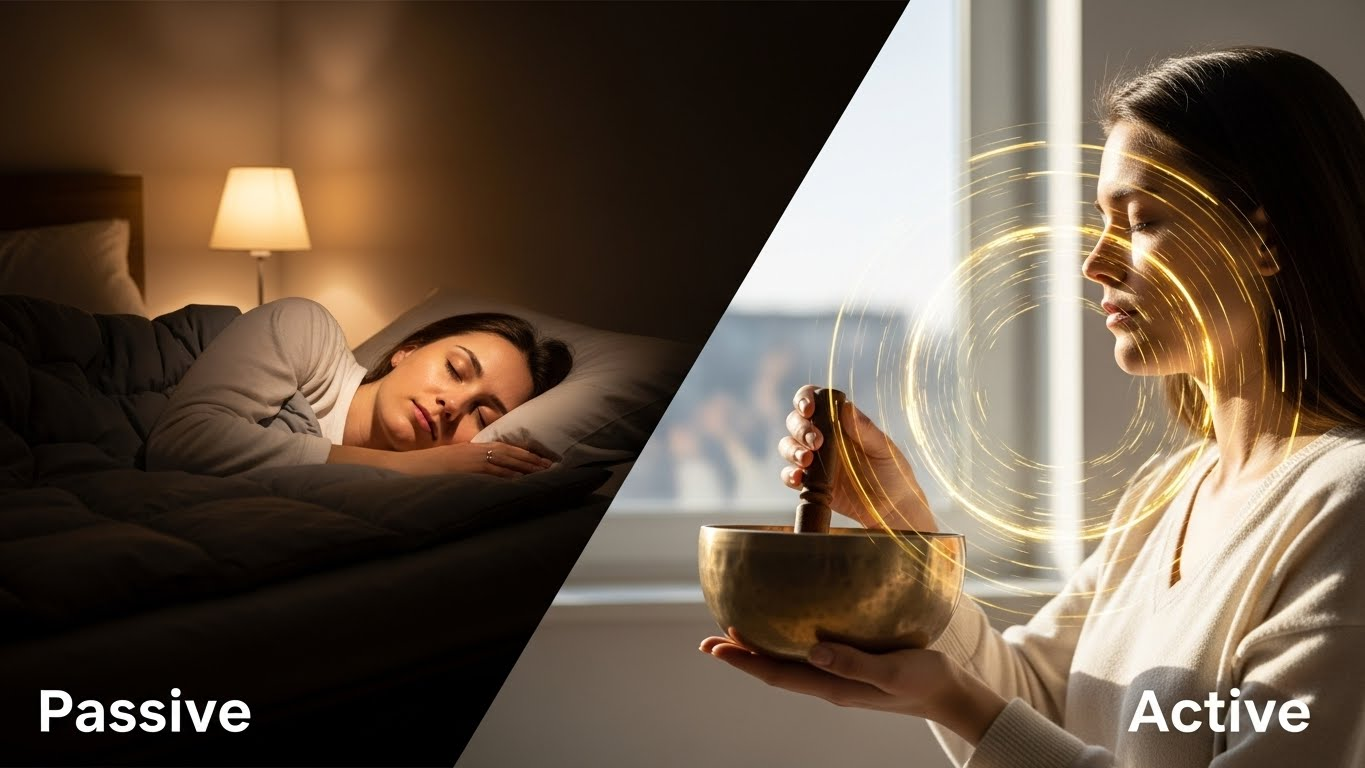
Passive rest is what most of us think of when we hear the word “relax.” It involves minimal physical or mental effort. This includes sleeping, napping, or sitting quietly. When we look at active vs. passive rest, passive rest is the foundation. It is essential for physical tissue repair and memory consolidation. During my deepest bouts of exhaustion, passive rest was the only thing I could manage, and it was necessary to keep my systems from crashing entirely.
However, there is a trap within passive rest: the “numb out.” Scrolling through social media for three hours isn’t actually passive rest; it’s sensory overload disguised as relaxation. True passive rest should feel like a soft landing. It’s the silence between notes. In sound therapy, we often talk about the importance of the “decay”—the moment after a bowl is struck when the sound fades into nothingness. Your body needs those moments of nothingness to recalibrate its baseline.
When Passive Rest is Not Enough
Consequently, have you ever slept for ten hours and still felt “foggy”? That is a sign that your fatigue isn’t just physical. If your mind is racing while your body is still, passive rest can actually feel like a prison. This is where we must transition into more dynamic forms of recovery to address the mental and emotional layers of our weariness.
Active Rest: Why Movement Can Be Meditative
Active rest is the intentional use of low-intensity activity to restore the nervous system. When considering active vs. passive rest, active rest is often the “missing link” for those with high-anxiety lifestyles. It includes activities like gentle yoga, walking in nature, journaling, or even sound bathing. These activities don’t drain your battery; they recharge it by clearing out the “emotional sludge” that builds up during a busy week.
For me, active rest looks like a Sound and Thought ritual. Instead of just lying in the dark, I use frequency and focused meditation to guide my brain waves from the frantic Beta state into the restorative Alpha or Theta states. This process requires a small amount of engagement, but the payoff is a much deeper sense of “reset” than a nap could ever provide. Active rest bridges the gap between the chaos of work and the stillness of sleep.
The Science of “Flow” in Recovery
Furthermore, active rest often puts us into a “flow state.” When you are gardening or painting, you aren’t “working,” but you are occupied. This focused attention gives the analytical part of your brain a much-needed break while keeping your body’s energy moving. According to the Sleep Foundation, active recovery can even help clear lactic acid and improve circulation better than total stillness.
How to Choose the Right Rest for Your Nervous System
The secret to choosing between active vs. passive rest lies in listening to your body’s unique “hum.” If your body feels heavy, your limbs feel like lead, and your eyes are burning, you likely need passive rest. Give yourself permission to sleep. However, if you feel “wired but tired”—where your body is exhausted but your mind is buzzing with frantic energy—you almost certainly need active rest to discharge that sympathetic nervous system arousal.
I began to treat my rest like a prescription. I would ask myself: “Is my exhaustion coming from my muscles, my brain, or my spirit?” If it was my spirit, I chose sound healing. If it was my muscles, I chose a hot bath (passive). If it was my brain, I chose a long walk without my phone (active). By matching the type of rest to the type of fatigue, I stopped wasting my weekends on “recovery” that didn’t actually recover anything.
Developing Somatic Awareness
Using tools for nervous system regulation allows you to make these choices more accurately. Somatic awareness is the ability to feel what is happening inside your body in real-time. When you are integrated, you don’t have to guess what you need; your body tells you.
Integrating Sound and Thought for Total Recovery
At the heart of the active vs. passive rest debate is the need for harmony. At Heal, we believe that sound is one of the most effective ways to facilitate active rest. Sound waves physically vibrate the cells in your body, acting as a deep-tissue massage for your nervous system. It is “active” because you are listening and processing the frequencies, but it feels “passive” because you are lying still.
This hybrid approach is incredibly powerful for those who find it hard to “just sit there.” By giving the mind a sound to follow, we prevent the “over-explaining” and “over-thinking” loops that often haunt our downtime. We move from a state of fragmentation to a state of integration. This is where true healing happens—not just in the absence of work, but in the presence of nourishing input.
The Role of Intention
Similarly, thought plays a huge role. If you are doing yoga but thinking about your inbox, it’s not rest—it’s just exercise. Active rest requires the “Thought” component of our mission. You must set an intention to be present with the movement or the sound, allowing the rest to permeate your entire being.
Conclusion: Restoring Your Inner Harmony
Ultimately, the goal is to create a lifestyle where rest is not an afterthought. Whether you choose active vs. passive rest, the most important factor is that you do it without the weight of guilt. You don’t owe the world constant productivity, and you don’t owe an explanation for your “down” days. By balancing the stillness of passive rest with the intentionality of active rest, you create a sustainable rhythm that supports your long-term wellness.
My life changed when I stopped trying to “power through” my exhaustion and started honoring the different frequencies of my needs. I invite you to explore the resources at Heal and The Soojz Project to find the tools that resonate with your journey. Remember, restoration is an art form. It’s about finding the melody that brings your mind and body back into sync. You are allowed to take up space, you are allowed to be still, and you are allowed to move at your own pace.
3 Key Takeaways
- Identify the Fatigue: Match passive rest to physical exhaustion and active rest to mental or emotional burnout.
- Avoid the “Numb Out”: Digital scrolling is sensory input, not rest. Replace it with intentional quiet or gentle movement.
- Use Sound as a Bridge: If you struggle with stillness, use sound therapy as an active-rest tool to help your nervous system transition into a healing state.


