
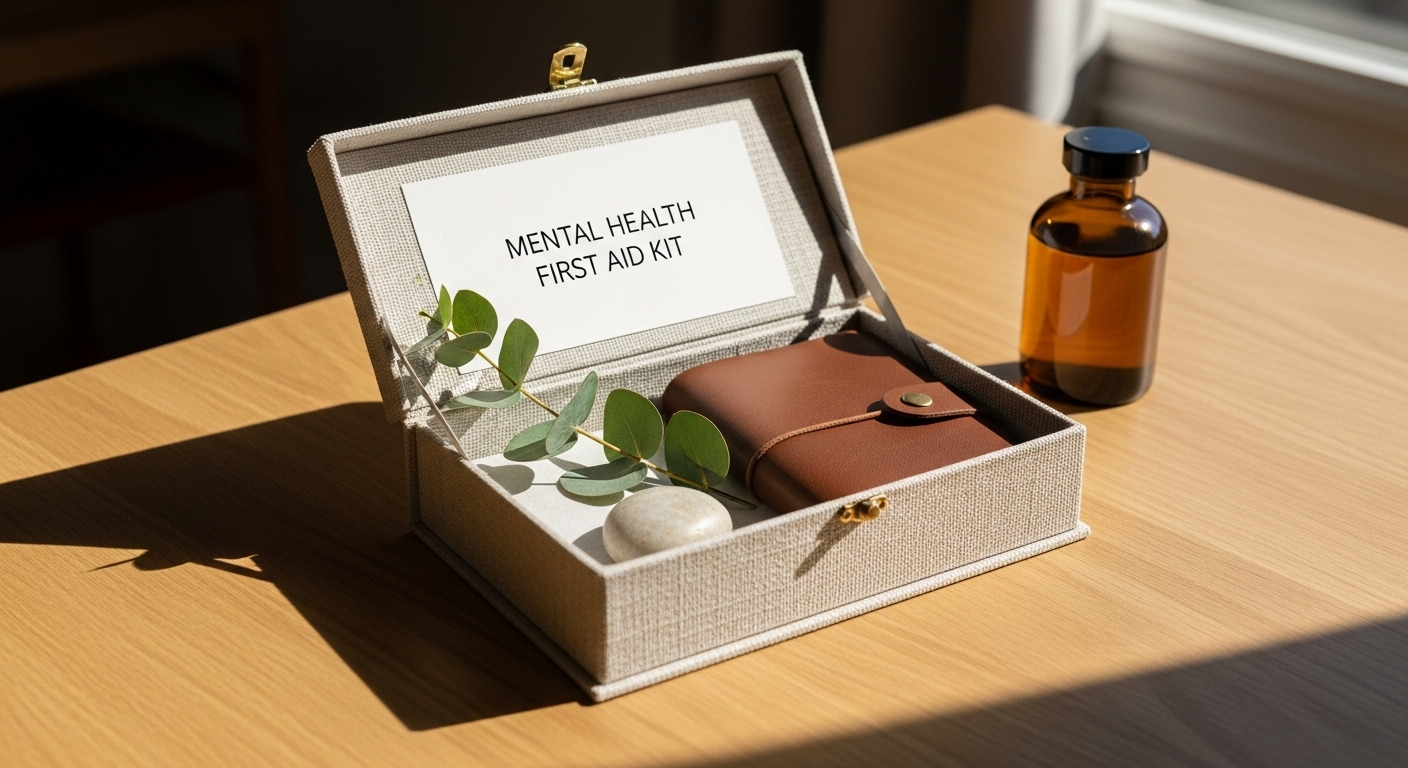
Why You Need a Personal Mental Health First Aid Kit Today
Creating a Mental Health First Aid Kit is one of the most proactive steps you can take for your emotional well-being. I used to believe that resilience was a fixed trait—something you were either born with or you weren’t. However, after struggling with sudden waves of overwhelm, I realized that the difference between spiraling and staying grounded is often just a matter of preparation. Most people don’t realize that waiting until you are in a crisis to find a coping mechanism is like trying to build a fire while standing in a freezing rainstorm.
In this guide, I will show you how to curate a Mental Health First Aid Kit. This physical or digital collection of tools grounds you when the world feels too heavy. Instead of relying on raw willpower, you will gain a specific, actionable blueprint for emotional healing. This post moves you from a state of reactive panic to a state of proactive peace. Additionally, this system provides a sense of calm authority over your own nervous system. It ensures you are never truly unarmed against stress.
Read Somatic Grounding: 5 Sounds to Stop a Panic Attack

Why does building a Mental Health First Aid Kit keep feeling stuck?
Many of us feel stuck in a cycle of emotional exhaustion because we rely on “willpower” rather than “systems.” When the nervous system triggers a fight-or-flight response, the prefrontal cortex—the logical, decision-making part of the brain—essentially goes offline. Therefore, you cannot “think” your way out of a panic attack if you haven’t pre-set your environment for success. The brain physically lacks the capacity for complex problem-solving when it perceives a threat.
Common advice often fails because it is too vague. Telling someone to “just breathe” ignores the physiological reality of distress. We stay stuck because our tools remain scattered across different apps or forgotten notebooks. Meanwhile, the lack of a tangible system reinforces the belief that we are powerless. Instead of feeling capable, we feel broken. The truth is simple: you aren’t broken, you are just under-equipped. Read Stop Fighting Yourself: Why Your Best Effort is Keeping You Stuck
Common Failures in Managing Emotional Overwhelm
Often, our disorganized attempts at self-soothing lead to further frustration. These ineffective patterns actually damage our mental health experience:
- Information Overload: You save hundreds of “healing” pins on Pinterest but never look at them during a crisis. This creates a “Wikipedia effect” where you have data but no direction.
- Diary-Style Venting: You write down problems without using search-aligned solutions. This often leads to “rumination loops” rather than actual resolution.
- Poor Accessibility: You keep your “kit” in a format that is difficult to navigate. If your tools stay behind three passwords and a dead battery, they don’t exist.
- Lack of Personality: You use generic lists that don’t resonate with your sensory needs. A lavender candle won’t help you if you hate the scent.
Transforming Your Approach to Mental Health First Aid
To achieve a true breakthrough, we must shift our perspective from “crisis management” to “environmental design.” Most people approach mental health like an amateur firefighter. They wait for the flames to erupt before searching for a bucket of water. However, the most effective way to manage distress is to install a sprinkler system before the first spark flies.
This shift moves us away from the “willpower myth.” Instead, we embrace the “System Strategy.” You rely on pre-vetted, tangible tools that do the heavy lifting for you. When your brain is in a state of high arousal, your cognitive load is maxed out. You literally do not have the mental “bandwidth” to choose a coping skill. By having a Mental Health First Aid Kit ready, you remove the burden of choice. Instead of asking “What should I do?” you simply reach for the box.
Lessons from My Real Experiments with Emotional Tools
In my experiments with grounding techniques, I noticed that the most effective tools aren’t the most expensive. They are the most sensory. I found that a physical object, like a smooth river stone, worked significantly faster than a meditation app. Digital screens can sometimes add to sensory overwhelm rather than subtracting from it.
Additionally, I observed that community members at soojz.com who categorized their kits by “Energy Level” saw much higher success rates. For instance, a “High Energy” kit for anger might involve cold water. A “Low Energy” kit for depression might involve soft textures. I noticed that a “one size fits all” kit often goes unused. It fails to meet the user where they are in that specific moment of distress.
The Strategy to Master Your Mental Health First Aid Kit
The “One Thing” that changes everything is Sensory Integration. Research shows that engaging the five senses bypasses the “stuck” thoughts of the amygdala. This communicates safety directly to the nervous system. Experts often call this “bottom-up” regulation.
Include items in your Mental Health First Aid Kit that address these categories:
- Scent (Olfactory): Use lavender for calming or peppermint for immediate grounding.
- Touch (Tactile): Grab a weighted blanket or a “worry stone.” Temperature changes effectively break a panic spiral.
- Sound (Auditory): Record a voice note from your “healthy self” or play a “Brown Noise” playlist.
- Sight (Visual): Keep a photo of a “safe place” or a card with a simple grounding mantra.
By integrating these strategies, your body learns to recognize these items as signals of safety. Therefore, the kit becomes a powerful Pavlovian trigger for peace.
Most Frequently Asked Questions About Mental Health First Aid Kits
- What is a Mental Health First Aid Kit? It is a curated collection of sensory items and actionable steps used to de-escalate distress. It acts as a physical “break glass in case of emergency” box.
- How do I start building my kit? Identify your primary triggers. Choose one item for each of the five senses that makes you feel safe. Place them in a dedicated container like a shoebox.
- Is a digital kit as effective? Physical items provide superior tactile grounding. However, a hybrid approach—a physical box at home and a “Safety” folder on your phone—works best for modern life.
- How often should I update it? Review your kit every three months. As you grow, your needs change. What comforted you during burnout might not work during a life transition.
Take the First Step Toward a Calmer You
Building your Mental Health First Aid Kit is an act of profound self-love. It is a promise to your future self. You are telling yourself: “I will be there to catch you when you fall.” Instead of fearing the next “low,” you can walk forward with quiet confidence. Do not wait for the next storm to start building your shelter.
3 Key Takeaways:
- Preparation over Willpower: Systems save you when thoughts fail. Rely on the box, not your brain.
- Sensory Focus: Use the five senses to ground your body instantly.
- Personalization: Your kit must reflect your unique needs. Build it your way.
Your Action List:
- Identify: Find a small box or a dedicated folder on your phone.
- Curate: Pick three items that instantly soothe your nervous system.
- Apply: Place them in your kit and use them at the first sign of stress.


Leave a Reply