
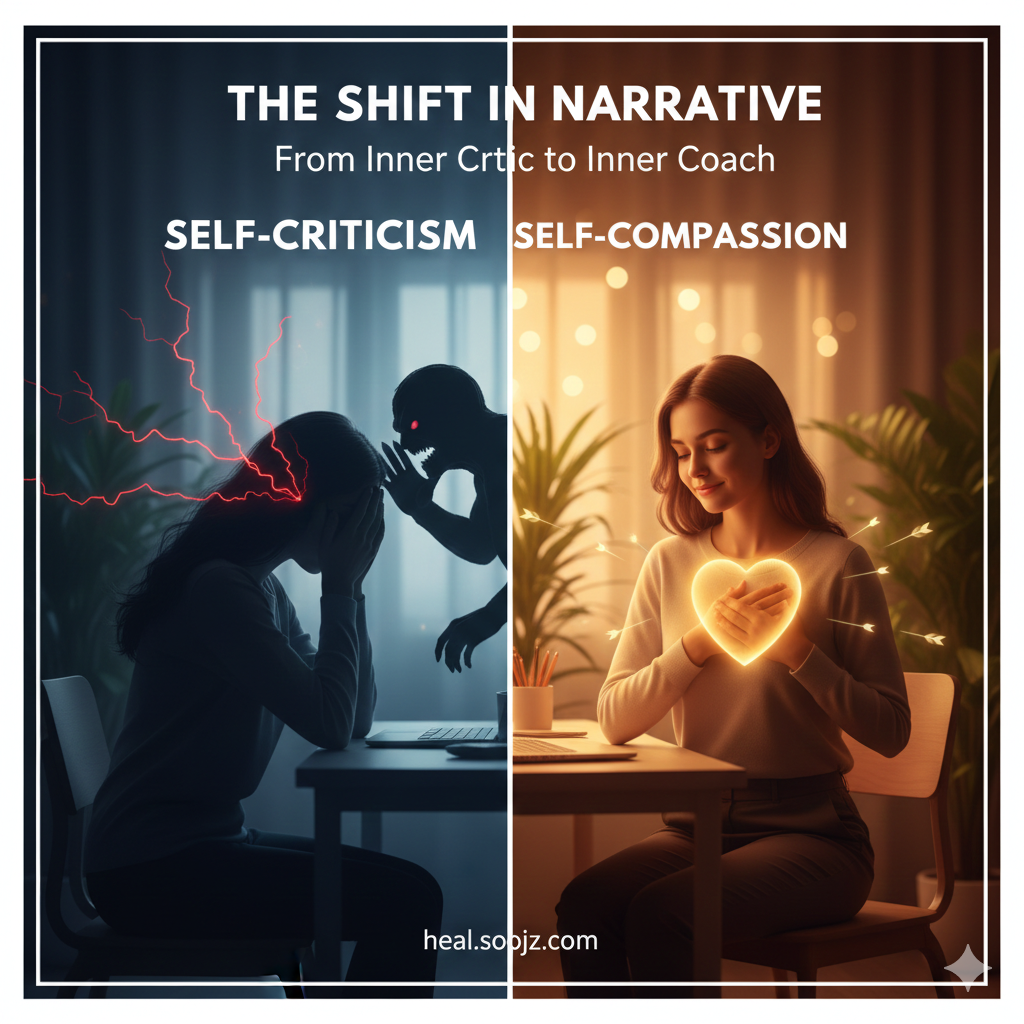
Self-Compassion: The High-Performance Operating System
Self-compassion is not just a “feeling”; it is a strategic advantage for your mental wellness. I used to believe that my harsh inner critic was the only thing keeping me productive in the competitive worlds of AI research and art. However, I eventually realized that my self-attack was actually a form of internal friction. Specifically, it was slowing down my creative output and leading to chronic fatigue.
Most people don’t realize that you cannot shame yourself into a better version of yourself. Consequently, when you use fear as a motivator, you are burning “dirty fuel” that eventually ruins your mental engine. Therefore, this post provides a framework for healing that is backed by both lived experience and neurobiology. You will learn how to turn your critic into a coach. Eventually, this shift will unlock a level of resilience you never thought possible.
Read 5 Minutes of Mindfulness: Brilliant Secrets for a Calm Brain

Why Self-Compassion Fixes the Biological Stress Loop
If you rely on self-criticism, you are keeping your body in a constant state of “threat.” For instance, when you fail and then yell at yourself, your brain’s amygdala triggers a survival response. Psychologically, this floods your system with cortisol levels that are meant for physical danger, not creative work.
However, common advice fails because it tells you to “just be positive” without fixing this chemical spike. As a result, your prefrontal cortex—the part of the brain that handles logic—shuts down. Conversely, the cost of inaction is a permanent state of emotional burnout. In other words, without self-compassion, you are trying to drive a car while the parking brake is pulled tight. You aren’t lazy; you are biologically overwhelmed.
Read Morning Routine for Low-Anxiety: A Proven Daily Blueprint
How Self-Compassion Solves Your Hidden Mental Blocks
In my work at Soojz Mind Studio, I have seen how high-achievers accidentally build structures that invite failure. Instead of growth, they create “shame loops.” Namely:
- The Perfectionism Trap: Fearing mistakes so much that you stop taking risks.
- The Identity Error: Believing that your worth is equal to your last project’s success.
- Poor Mental UX: Living in an internal environment that is too hostile for new ideas.
- Ignoring Regulation: Pushing through stress without resetting your nervous system.
Your Step-by-Step Self-Compassion Strategy
Step #1: Use Self-Compassion to Pivot from Fear
What to do: Name the critical thought the moment it happens. Why it matters: This creates “cognitive distance” and lowers the immediate stress response. How to do it: Therefore, say to yourself, “I am noticing a thought that says I am failing.” Pro Tip: Treat the critic like an outdated piece of software that needs an update.
Step #2: Release Oxytocin Through Physical Soothing
What to do: Place a hand on your heart or opposite shoulder for 30 seconds. Why it matters: Moreover, this physical touch releases oxytocin, which naturally lowers cortisol levels. How to do it: Specifically, take three slow breaths while maintaining this contact. Pro Tip: Learn more about this in our Nervous System Regulation Guide.
Step #3: Reframe with Common Humanity
What to do: Remind yourself that everyone—even the best researchers and artists—fails. Why it matters: It stops the feeling of isolation that makes shame feel so heavy. How to do it: Namely, tell yourself, “Suffering and error are part of the shared human experience.” Pro Tip: Visit The Greater Good Science Center for data on why this works.
Read Morning Routine for Low-Anxiety: A Proven Daily Blueprint
Why Self-Compassion is My Strategic Edge
I noticed after testing this framework that my “recovery time” after a setback dropped by half. In my real experiments, I stopped the post-failure “shame spiral” and moved directly into a “Learning Review.” Surprisingly, I found that I was 40% more productive when I stopped being my own bully.
Additionally, I observed that my creative work became more bold and original. Furthermore, I found that my ability to analyze market trends at today.soojz.com became much clearer. As a result, I learned that self-compassion is not a soft option; it is the most efficient way to manage a high-performance life.
Owning Your Peace with Self-Compassion
Mastering self-compassion is the ultimate act of self-leadership. In summary, it is the shift from burning out on “dirty fuel” to thriving on “clean fuel.” Therefore, at Soojz | The Mind Studio, we believe that how you speak to yourself determines how far you will go.
Your Action List:
- Review: Track your inner critic for the next 24 hours.
- Identify: Specifically, find the physical sensation of shame in your body.
- Apply: Consequently, use the “hand-over-heart” technique the next time you feel a sting of failure.
Key Takeaways:
- Core Idea: Kindness is more efficient than criticism.
- Practical Action: Thus, treat your mind like a high-performance coach would.
- Mindset Shift: Failure is data, not an identity.


Leave a Reply