

The Heart of The Soojz Project
The use of nature frequencies is a primary focus of The Soojz Project, as we address the sensory malnutrition of the modern world. We acknowledge that your nervous system evolved in an environment of complex, organic sound, not static humming. Specifically, we believe that “white noise” is often a digital band-aid that masks a problem rather than solving it. We understand that your cells crave the “infinite curves” of natural resonance. Consequently, we use tools like the Daegeum to provide the biological nourishment your brain needs to drop into a state of deep, restorative rest.
- Sound: My album, Heavy Bamboo Rain, uses the organic “buzz” of the bamboo membrane to mimic the complex chaos of a living forest.
- Insight: Through Soojz Mind Studio, we analyze how “pink noise” and natural frequencies improve heart rate variability compared to static digital tones.
- Action: The Speak Love to Yourself series encourages an “unplugged” evening environment to lower the noise floor of your life.

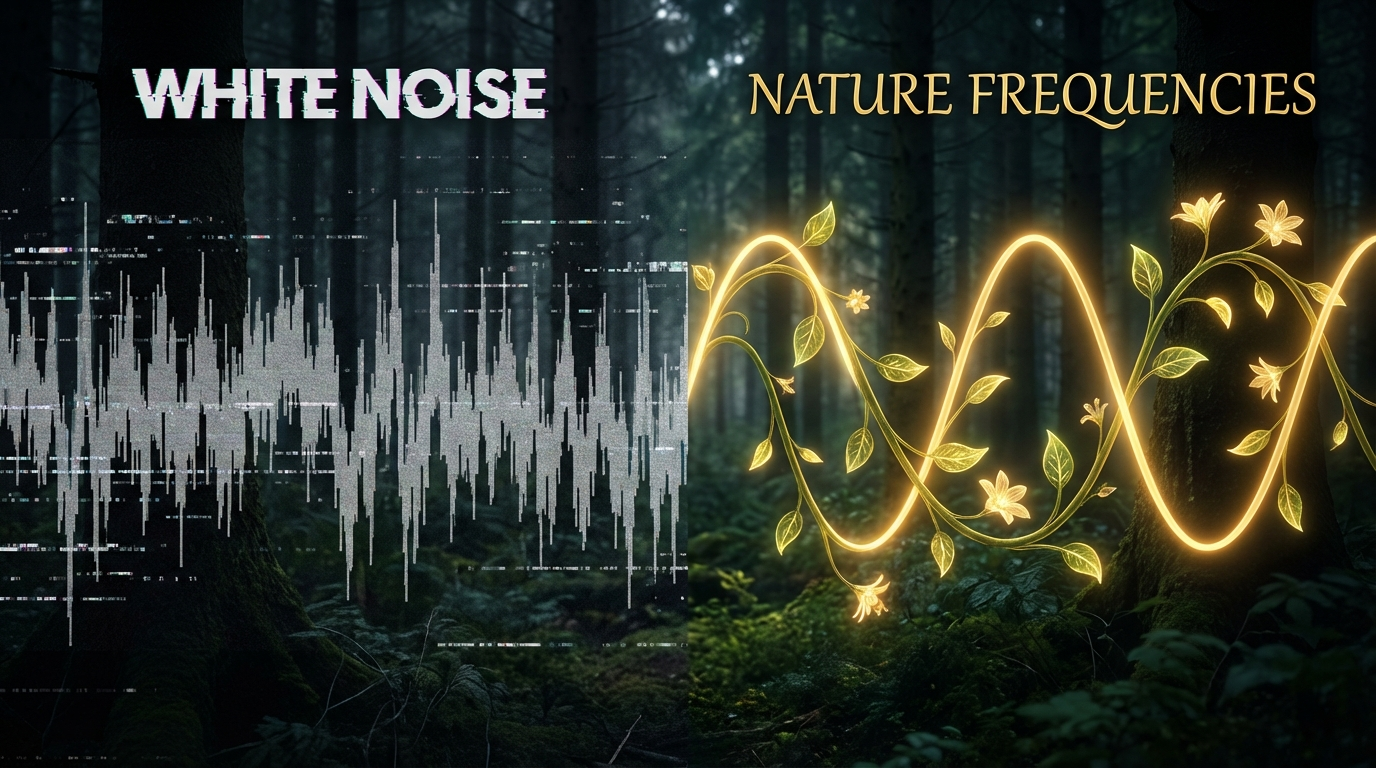
Why Nature Frequencies Win Over White Noise
White noise is a flat, consistent signal that contains all audible frequencies at equal intensity. Instead, nature is non-linear and dynamic. As a researcher into AI and human recovery, I see white noise as a “wall” we build to hide from the world. While it can block out a snoring partner or a loud street, it provides no “data” for the brain to process.
I call this “Sensory Flattening.” It occurs when your brain gets bored of a static signal and begins to “hallucinate” sounds within the noise. Specifically, nature frequencies—like rain, wind, or the Daegeum—provide “fractal” information. Your brain is wired to decode these patterns. Therefore, we don’t just “mask” noise. Instead, we provide a resonant environment that tells your Vagus nerve that the “coast is clear.”
read Nature Frequencies vs White Noise.
5 Key Mechanisms: Why Your Biology Prefers Nature
1. The Physics of Fractal Information
Nature is mathematically non-linear. Specifically, nature frequencies are fractal, meaning they repeat complex patterns at different scales. For example, the sound of a rainstorm is a symphony of thousands of individual droplets hitting varying surfaces. Your brain is a pattern-recognition machine that “relaxes” when it has high-quality data to decode. In contrast, white noise is a mathematical void that leaves the brain searching for meaning in the static.
2. Epigenetic Responding to Organic Texture
Science suggests that our cells respond to the physical “shape” of sound waves. Namely, your cells “prefer” the smooth, organic vibrations of bamboo and wood over the “stepped” samples of digital audio. As a result, listening to the Daegeum triggers a different hormonal response than listening to a digital fan. For example, the organic woodwind frequencies provide a “texture” that your biology recognizes as an environmental safety signal.
3. Vagus Nerve Entrainment via the “Cheong”
Your Vagus nerve is highly sensitive to timbre and resonance. Specifically, the Daegeum uses a “Cheong” (bamboo membrane) that creates a specific buzzing frequency. For example, when you hear that organic buzz, it mimics the “purr” found in restorative natural environments. This provides a direct physical massage for the Vagus nerve. Therefore, you move from a state of “masked stress” to a state of actual biological synchronization.
4. Harmonic Resonance vs. Artificial Masking
Masking occurs when you try to drown out a sound with a “wall” of noise. In contrast, resonance occurs when your brainwaves “merge” with the signal. Specifically, nature frequencies provide a carrier wave that your brain can easily follow down into Theta and Delta states. For example, the rhythmic pulse of a bamboo forest provides a steady “beat” that your internal clock can synchronize with, making sleep a natural transition.
5. Breaking the Low-Frequency “Digital Hum”
Modern cities bathe us in the “Low-Frequency Hum” of electronics and traffic. Namely, white noise often just adds more “unnatural hum” to the pile. Consequently, your recovery requires a “frequency purge.” Reclaiming your rhythm means replacing that artificial static with the “High-Resolution” sounds of the earth. For example, switching from a machine hum to the organic resonance of “Heavy Bamboo Rain” changes the energy density of your bedroom.
The Soojz Nature Frequency Protocol (How-to)
To move beyond white noise and reclaim your sensory sovereignty, use this 15-minute routine:
- Sonic De-Compression (5 mins):
- How-to: Turn off all artificial hums (fans, AC, white noise machines). Sit in the silence for two minutes. This “clears the palate” of your ears. Notice the “noise floor” of your house. Specifically, identify the “stale” sounds you usually ignore.
- Harmonic Immersion (7 mins):
- How-to: Play Heavy Bamboo Rain at a low volume. Specifically, focus on the “buzz” of the membrane. Imagine the sound is a physical mist filling the room. As a result, your brain stops “searching” for threats and starts “resting” in the frequency.
- Vocal Mirroring (3 mins):
- How-to: Hum along with the lowest note of the flute. Match your internal vibration to the bamboo. Consequently, you are no longer a “listener” to nature; you are a “participant” in the resonance.
The Soojz Project Ecosystem
- Recovering Me: Learn how to detox from the “digital noise” of a toxic environment.
- Not Just Me: Real stories of using organic sound to heal sleep disorders.
- Heal.Soojz.com: Home of Soojz Mind Studio and our nature frequency tools.
References & External Resources
- Nature vs. Artificial Noise: Research on how natural soundscapes decrease the “fight or flight” response compared to artificial noise via Scientific Reports | Nature Journal.
- Fractal Sound Patterns: A look at why the human brain relaxes when processing the mathematical complexity of nature via The Smithsonian Magazine.
- Vagal Tone and Sound: Understanding how specific frequencies and timbres stimulate the Vagus nerve via The Polyvagal Institute.
- The Impact of 528Hz: A study on how the “Love Frequency” reduces cortisol levels and anxiety via The National Library of Medicine (PubMed).
- Pink Noise and Sleep: Why non-linear noise improves deep sleep and memory consolidation via The Journal of Theoretical Biology.
- Cymatics and Cellular Health: How physical vibrations impact the structure of water and biological cells via The Resonance Science Foundation.


Leave a Reply