
Introduction: The War Inside My Ribcage
Achieving true nervous system safety was the missing piece in my own recovery from chronic anxiety and the “biological bracing” that kept me trapped in survival mode.
For years, I lived with a vibration in my chest that never quite went away. It felt like an engine idling too high, a constant, low-level hum of dread that no amount of “positive thinking” could silence. I treated my anxiety like a character flaw—a personal failure of will. I told myself that if I just worked harder, meditated longer, or “fixed” my thoughts, the tension would finally vanish.
But the mind cannot fix what the body refuses to let go of.
As a researcher in AI and human recovery, I eventually realized the painful truth: My mind wasn’t the problem. My nervous system safety was. I was trapped in a state of chronic “Biological Bracing,” a phantom survival mode where my body remained perpetually armored for a disaster that had already passed.
I remember sitting in a legal mediation with a former employer, my pulse hammering against my throat so hard I could barely speak. Logically, I knew I was in a safe room with legal counsel. But my nervous system didn’t care about logic. To my Vagus nerve, that mediation was a hunt, and I was the prey.
Specifically, your body cannot distinguish between a predator in the wild and a toxic inbox or a legal battle. It only knows the frequency of threat. We often try to think our way out of stress, but you cannot debate with a heartbeat that is convinced it’s running for its life. Real healing only begins when we stop arguing with our thoughts and start physically proving to our cells that the war is over. Until the body feels safe, the mind is not allowed to be still.

Why Nervous System Safety is the New Priority
Anxiety is often treated as a mental malfunction or a character flaw. Instead, as a researcher into AI and human recovery, I see it as a high-definition alarm system that has lost its “off” switch. In modern life, your nervous system safety is compromised by digital noise, social pressure, and ancestral trauma. We are living in a state of chronic “Neuroception”—the subconscious process where our brain scans the environment for danger—without ever finding a moment of true resolution.
I call this “Biological Bracing.” It occurs when your Vagus nerve stays in a state of hyper-vigilance, preparing your organs for an attack that never arrives. Specifically, your body cannot tell the difference between a predator in the wild and an overflowing inbox or a critical comment on social media. Therefore, we don’t try to “think” our way out of stress. Instead, we focus on nervous system safety to physically prove to our brain that the environment is secure. Until the body feels safe, the mind cannot be still.
The Guardian Within: Understanding the Polyvagal Framework
To understand nervous system safety, we must look at the work of Dr. Stephen Porges and the Polyvagal Theory. Your nervous system acts like an internal guardian, constantly shifting between different states of arousal. Specifically, it operates on a hierarchy. At the top is the “Social Engagement System” (Ventral Vagal), where we feel safe, connected, and creative. Below that is the “Sympathetic System” (Fight or Flight), and at the bottom is the “Dorsal Vagal” (Freeze or Shutdown).
When your nervous system safety is compromised, you drop down this ladder. You might find yourself snapping at loved ones (Fight) or feeling a deep, heavy numbness that prevents you from getting out of bed (Freeze). Namely, these aren’t choices; they are autonomic reflexes. Understanding this changes everything. Instead of judging your anxiety, you begin to see it as a guardian that is trying too hard. By providing specific somatic signals, you can help that guardian stand down and return to the Ventral Vagal state of peace.
5 Key Mechanisms: How to Communicate Safety to Your Body
1. The Physics of Vagus Nerve Entrainment
Your Vagus nerve acts as a biological microphone, picking up the frequency of your environment. Specifically, nervous system safety is established when you provide a steady, organic rhythm for the nerve to follow. Digital sounds are often jagged and compressed, which keeps the nerve in a state of “startle.”
- For example: Listening to the Daegeum (bamboo flute) creates a specific resonance. Because the wood and membrane vibrate at a natural frequency, your Vagus nerve “entrains” or matches that rhythm. Consequently, your heart rate slows down automatically because your body recognizes the sound of safety. You are replacing digital static with biological harmony.
2. Epigenetic Responding to Compassionate Connection
Science now suggests that our internal chemistry shifts when we feel seen and respected. Namely, your nervous system safety is reinforced through co-regulation—the phenomenon where one calm person helps settle another. This is why a soft voice or a gentle touch can instantly lower cortisol.
- For example: When you interact with a safe person or even a pet, your body releases oxytocin. This chemical signal tells your DNA that it is safe to prioritize repair over defense. As a result, your baseline stress levels begin to drop because your cells no longer feel they are under siege. You are literally changing your gene expression through the power of safety.
3. Restoring Interoceptive Sovereignty
Interoception is the ability to feel your heart, your breath, and your gut without the filter of fear. Specifically, a lack of nervous system safety makes these sensations feel scary or “too loud.” Many people who have experienced trauma become “disconnected” from their bodies because the internal signals are too painful to track.
- For example: When your heart races, you might interpret it as an impending disaster. To reclaim calm, you must practice “Biological Auditing”—noticing the sensation and gently telling your body: “I feel you, and we are safe.” Consequently, you move from being a victim of your sensations to being their sovereign observer. This is the path back to internal trust.
4. Breaking the “Narcissistic Proxy” Alarm
If you have experienced toxic relationships or high-pressure environments, your nervous system safety might be compromised by what I call a “proxy” alarm. Namely, you may have inherited someone else’s fear or criticism, and your body is still scanning for their disapproval even when they aren’t there.
- For example: You might flinch at loud noises or feel “guilty” for resting. This is not a personal flaw; it is a protective echo. Recovery requires a “frequency purge”—using 528Hz sounds and somatic grounding to overwrite the old alarm with your own organic rhythm. You are reclaiming your body from the ghosts of the past.
5. Tactile Re-Scripting of the Stress Response
You cannot talk a body out of a “freeze” response; you must touch it out. Specifically, your skin—your largest sensory organ—needs tactile proof that the immediate environment is secure. When we are anxious, we often feel “floaty” or ungrounded.
- For example: Using Speak Love to Yourself allows you to physically move your hands in a repetitive, creative way. This provides a “grounding signal” to the brain. Moreover, the friction of the pencil on the page is a real-world sensation that counters the “nothingness” of digital numbness. You are anchoring your awareness back into the physical world.
The Science of Sudden Anxiety: Why “Out of Nowhere” Happens
Have you ever felt perfectly fine, only to be hit by a wave of panic ten minutes later? This happens because your nervous system safety is managed by the amygdala, which processes threats faster than the conscious mind. Specifically, your body might have picked up a “micro-trigger”—a certain smell, a tone of voice, or even a specific lighting—that reminded it of a past danger.
Because the body remembers what the mind forgets, these reactions feel sudden. However, they are actually “accumulated tension.” Your nervous system is simply running an old script. Therefore, the goal isn’t to stop the triggers, but to increase your “Window of Tolerance.” By building a daily practice of nervous system safety, you teach your body that it has the resources to handle these spikes. You move from “reacting” to “responding.”
The Soojz Safety Plan Protocol (How-to)
To move from “High Alert” back to “Rest and Digest,” use this daily nervous system safety routine. Consistency is more important than intensity.
- Sonic Grounding (5 mins):
- How-to: Put on Heavy Bamboo Rain. Sit with your spine supported and feet flat on the floor. Specifically, focus on the lowest, most resonant notes of the flute. Imagine the sound is a heavy, warm blanket settling over your shoulders. As a result, you are using sound to physically weight your nervous system into the present moment.
- The 4-6 Breath Audit (3 mins):
- How-to: Inhale deeply through your nose for 4 seconds, then exhale slowly through pursed lips for 6 seconds. Namely, making the exhale longer than the inhale is a direct biological “hack” for the Vagus nerve. It signals to the brain that there is no immediate threat. Consequently, your “fight or flight” system begins to power down.
- Tactile Affirmation (7 mins):
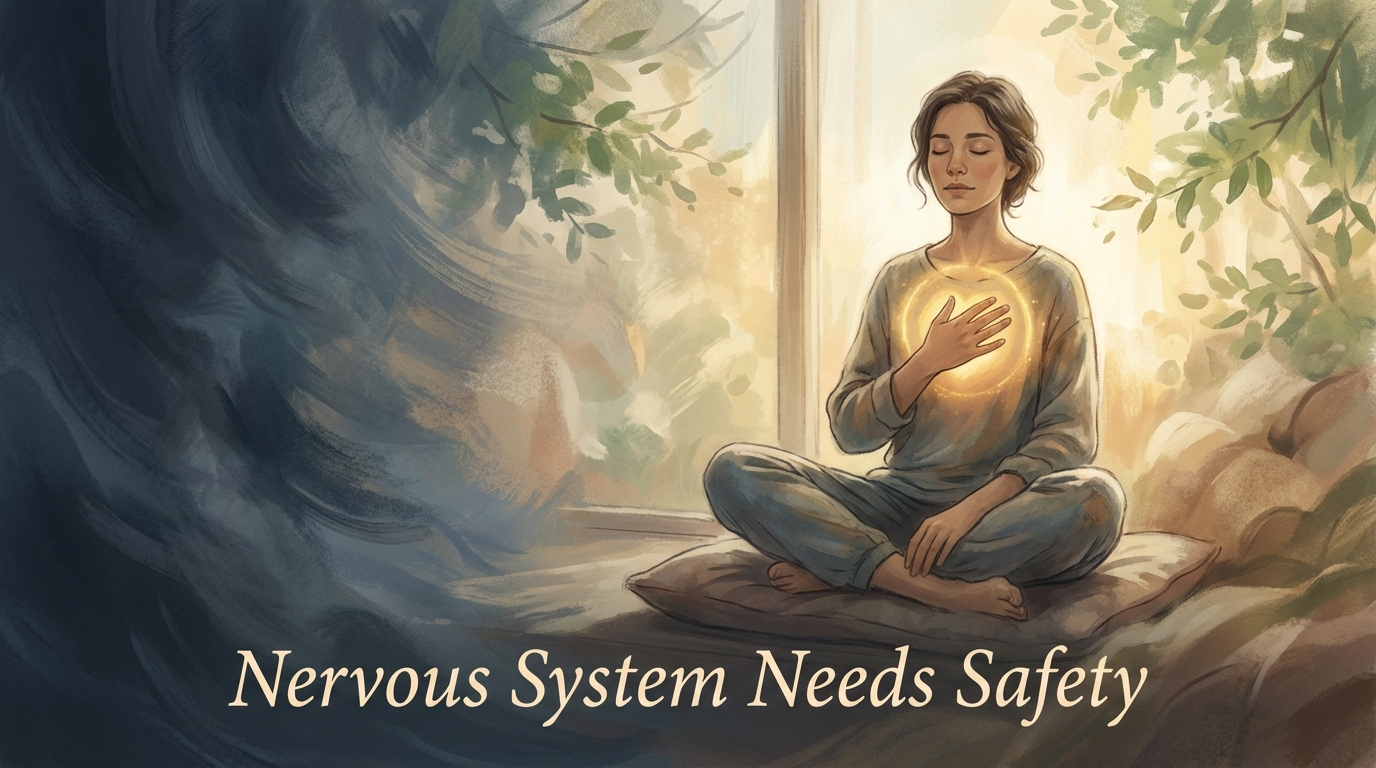
- How-to: Place one hand on your heart and the other on your belly. Feel the warmth of your skin. Say out loud in a low, calm voice: “My body is safe to be in right now.” As a result, you are providing both the physical and auditory proof your cells need to initiate a nervous system safety reset.
Conclusion: Reclaiming Your Biological Sovereignty
At The Soojz Project, we believe that your nervous system doesn’t need perfection—it needs safety. Anxiety, tension, or numbness are not flaws but signals from a body craving protection. When you start listening instead of suppressing, healing becomes possible. Every breath, every grounding exercise, and every gentle act of self-care tells your system: You’re safe now.
Moreover, healing doesn’t mean you’ll never feel anxious again. It means you’ll trust your body to come back from it faster each time. You are building a “resilience reservoir.” The path to calm isn’t found in control but in compassion. When you create safety inside yourself, your world begins to shift outside too. Your nervous system has been protecting you all along. Now, it’s time to protect it back—with presence, kindness, and patience. Stay in the presence of safety. Reclaim your frequency. Your peace is your power.
The Heart of The Soojz Project
The concept of nervous system safety is a primary focus of The Soojz Project, as we address the biological reality that anxiety isn’t just a thought—it is a physical state. We acknowledge that your body is constantly scanning for threats in a world designed to keep you on high alert. Specifically, we believe that healing begins when you stop fighting your reactions and start providing the “All Clear” signal to your cells. We understand that your body has been protecting you through tension and hypervigilance. Consequently, we use tools like the Daegeum and tactile rescripting to help you communicate safety to your Vagus nerve.
- Sound: My album, Heavy Bamboo Rain, provides a stable, grounding frequency that helps settle a buzzing, anxious system.
- Insight: Through Soojz Mind Studio, we explore how interoception—the ability to feel your internal world—is the foundation of somatic sovereignty.
- Action: The Speak Love to Yourself series provides the low-friction tactile movement needed to move out of a “freeze” state.


Leave a Reply