
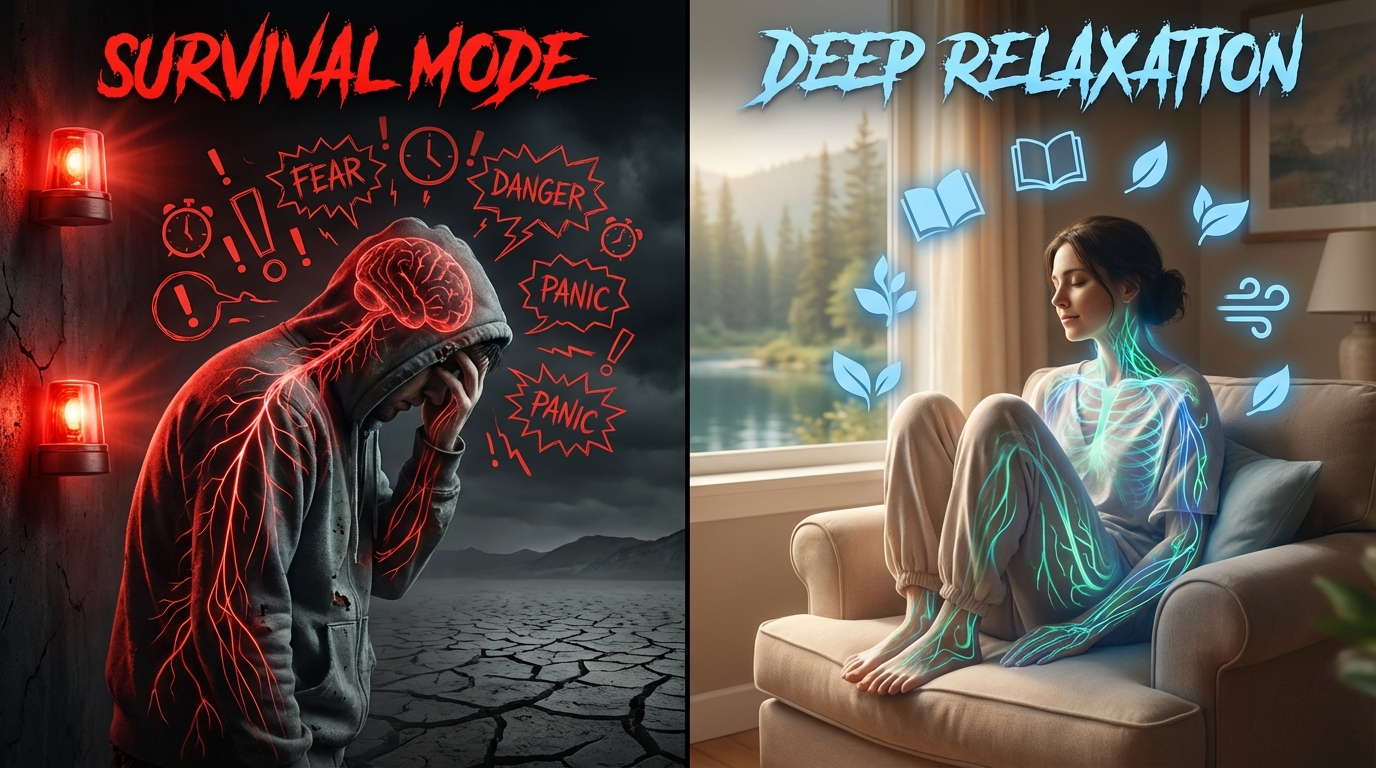
The Biology of the “Unrelaxable” Mind
Survival mode represents a sophisticated physiological state designed to keep you alive under pressure. I often describe this state as an engine running at redline while the car stays in park. As an AI researcher, I recognize how systems prioritize immediate threats over long-term maintenance. Specifically, I found that when your brain perceives a crisis, it mutes the systems required for restoration. Consequently, you might lie in bed for eight hours and wake up feeling chemically exhausted.
The biological reality of this sabotage involves the autonomic nervous system. Namely, your body cannot simultaneously occupy a state of defense and a state of growth. Therefore, “trying” to relax while in a state of high alert often feels like a physical battle. Instead of failing at meditation, you are actually experiencing a direct conflict in your internal wiring. This post explores the proven reasons why survival mode blocks your path to peace.

This space at Soojz Mind Studio is dedicated to restoring inner harmony through sound, thought, and conscious awareness. The Heal pillar at heal.soojz.com explores how we reconnect with ourselves beyond overwhelm, bridging psychological insight with the healing power of frequency and mind–body integration.
Soojz Mind Studio: Restoring Inner Harmony Through Sound and Thought
https://heal.soojz.com/
1. Cortisol and the High-Alert Feedback Loop
I recognize that the primary saboteur of rest is the chronic presence of stress hormones. Furthermore, I understand that high-achievers often run on “functional adrenaline” for years without noticing. Specifically, I spent a decade believing that my “drive” was just a personality trait. However, my body was actually trapped in a loop of elevated cortisol. This hormone serves a vital purpose during an actual emergency.
In fact, research suggests that prolonged cortisol exposure desensitizes the brain to the signals of safety. According to the Mayo Clinic, overexposure to cortisol disrupts almost all your body’s processes. Nevertheless, I found that the brain in survival mode views relaxation as a vulnerability. Consequently, your mind generates “to-do list” intrusive thoughts the moment you try to sit still. It is trying to keep you “ready” for a threat that has already passed.
2. The Functional Freeze and Numbness
To understand why deep relaxation feels scary, we must look at the “Functional Freeze” response. Specifically, when stress becomes too much to process, the nervous system shifts into a state of dorsal vagal shutdown. I noticed that during my most stressful years, I didn’t feel “stressed”—I felt nothing. This reflects a state where survival mode has successfully numbed your internal radar.
Additionally, I observed that “relaxing” into this numbness can actually trigger a panic response. I view this as the “relaxation-induced anxiety” phenomenon. This aligns with Polyvagal Theory, which explains how the body interprets a drop in heart rate as a dangerous loss of vigilance. By honoring this biological guard, I realized that I couldn’t just “relax” my way out of a freeze. Instead, I had to gently signal to my body that the environment was truly safe.
3. Sensory Overload and the “Search for Problems”
Identifying a state of survival mode requires looking at how you process sensory data. Since the survival brain prioritizes threat detection, it becomes hyper-aware of every sound, light, and movement. Specifically, I found that I could no longer enjoy “quiet time” because the silence felt loud with potential problems. My brain was essentially looking for a reason why it wasn’t currently fighting.
Moreover, I have felt my nervous system “redline” simply from having too many open browser tabs. Consequently, I realized that digital clutter maintains the “threat” signal in the background. At Soojz Mind Studio, I focus on the “Sensory Audit” as a prerequisite for rest. Namely, you cannot achieve deep relaxation if your brain is still scanning for predators in your inbox. The final stage of recovery involves manually lowering the noise floor so the body can finally drop its guard.
4. Reclaiming the Original Blueprint of Rest
We are born with a perfect “Rest and Digest” cycle. However, modern life teaches us to view survival mode as the standard operating system. We learn to celebrate the “hustle” and ignore the shallow breathing. Consequently, we lose the blueprint of our original, regulated self. This concept is explored deeply in The Body Keeps the Score, which explains how trauma stays locked in the tissues.
By understanding these proven reasons, you are practicing a form of neurological empathy. You are realizing that your “inability to relax” is not a personal failure. Specifically, it is a highly efficient biological protection program. According to the American Psychological Association, learning to move out of this state requires consistent, small signals of safety. By bringing awareness to your survival mode, you allow the system to finally begin the “cool down” process.
✅ Conclusion: Moving Beyond the Hustle
I have learned that deep relaxation is a physiological achievement, not a passive act. Instead of judging my “restless” mind, I now thank my nervous system for trying to protect me. My work with the Daegeum has taught me that the best music requires both tension and release. Therefore, I invite you to stop “trying” to relax and start looking for small ways to signal safety to your body right now.
Your Action List:
- The Sensory Audit: Turn off the overhead lights and put your phone in a drawer for 15 minutes.
- Somatic Signal: Place one hand on your belly and take a long, slow exhale that is longer than your inhale.
- Engage: I recommend reading about the mental static flush to clear the noise that keeps you in survival mode.
Soojz Mind Studio: Restoring Inner Harmony Through Sound and Thought
https://heal.soojz.com/
This space at Soojz Mind Studio is dedicated to restoring inner harmony through sound, thought, and conscious awareness. The Heal pillar at heal.soojz.com explores how we reconnect with ourselves beyond overwhelm, bridging psychological insight with the healing power of frequency and mind–body integration.


Leave a Reply