
After narcissistic abuse, one of the most exhausting experiences can be overthinking. Your mind gets stuck in a constant loop, replaying every conversation, every action, and every detail as you search for answers. You might ask yourself: Why is this happening to me? What did I miss? Could I have done something differently?
These questions rarely bring answers. Instead, they lead to more confusion, self-doubt, and exhaustion. The more you try to make sense of what happened, the more you lose touch with yourself. It can feel like a dark, lonely place—but you don’t have to stay there forever.
I eventually realized that this overthinking wasn’t a personality flaw or a sign that I was weak. Rather, my brain developed this survival strategy to keep me safe in an unpredictable environment. Breaking this cycle is a fundamental part of reclaiming me.

1. Did I Miss Something? The Illusion of the Missing Piece
When someone manipulates you, you often feel like you’ve missed something important. Narcissists twist the truth, gaslight you, and leave you questioning everything about yourself. After the abuse, overthinking can take on a new dimension. Suddenly, nothing seems clear. You might find yourself replaying every interaction, looking for the moment where you went wrong. You think to yourself: If I just did something differently, maybe things wouldn’t have ended up this way.
This specific type of overthinking is a trap. Because you are a rational person, you assume that if a relationship failed, a logical turning point must have existed. You search for the missing piece of the puzzle, believing that if you find it, the whole picture will finally make sense.
However, in a narcissistic dynamic, missing pieces defined the puzzle from the very beginning. The narcissist intentionally leaves gaps in the narrative and twists facts to keep you in a state of perpetual confusion. This fog forces you to look inward for faults rather than outward at their behavior. Reclaiming me means accepting that you didn’t miss a clue; you simply followed a map to a destination that doesn’t exist.
2. The Echo of Survival: Understanding Hyper-vigilance
When I lived with a narcissist, I was always walking on eggshells. I had to predict their moods, analyze their tone of voice, and calculate every possible outcome of a conversation just to avoid the next verbal blow. My brain entered a state of chronic hyper-vigilance, a biological state described in the Polyvagal Theory as a constant state of high-alert. This was a necessary survival tactic at the time; if I could anticipate the storm, I could find a way to mitigate the damage.
The problem is that our brains do not have a simple off switch for this level of intense scanning. Once I was free, that survival radar stayed on at full power. Even in a quiet room, my mind was searching for a hidden threat. It continued to analyze past conversations, looking for clues I might have missed, and rehearsing future worries to ensure I would never be blindsided again.
This constant mental churning is the brain trying to protect a version of me that was once under siege. Reclaiming me began with recognizing that overthinking was actually my brain trying to love me through an outdated survival manual.
3. The Fog of Gaslighting: Rebuilding Trust in Reality
Gaslighting specifically targets your trust in your own intuition. When my memories, feelings, and observations were constantly denied or twisted, I gradually stopped believing my own conclusions. I was conditioned to look outside of myself for the truth, usually to the person who was actively distorting it. This created what psychologists call Cognitive Dissonance, a deep internal fracture where I felt I could no longer rely on my own eyes and ears.
In the aftermath, this manifests as a desperate need to find certainty through overthinking. I would analyze a single event dozens of times, looking for an objective proof that I wasnt crazy or that I had truly been wronged. Because there is no logical answer to a narcissists irrational behavior, my brain stayed in a feedback loop trying to solve a puzzle with missing pieces.
Part of reclaiming me was accepting that I do not need the abusers admission of guilt to validate my own reality. I had to stop the external search for truth and begin the quiet, slow process of believing myself again.
4. From Thinking to Feeling: The Path Back to Center
I learned that trying to stop overthinking by thinking more was an exercise in futility. To cool down an overheated brain, I had to return to my physical senses and engage the body in the healing process.
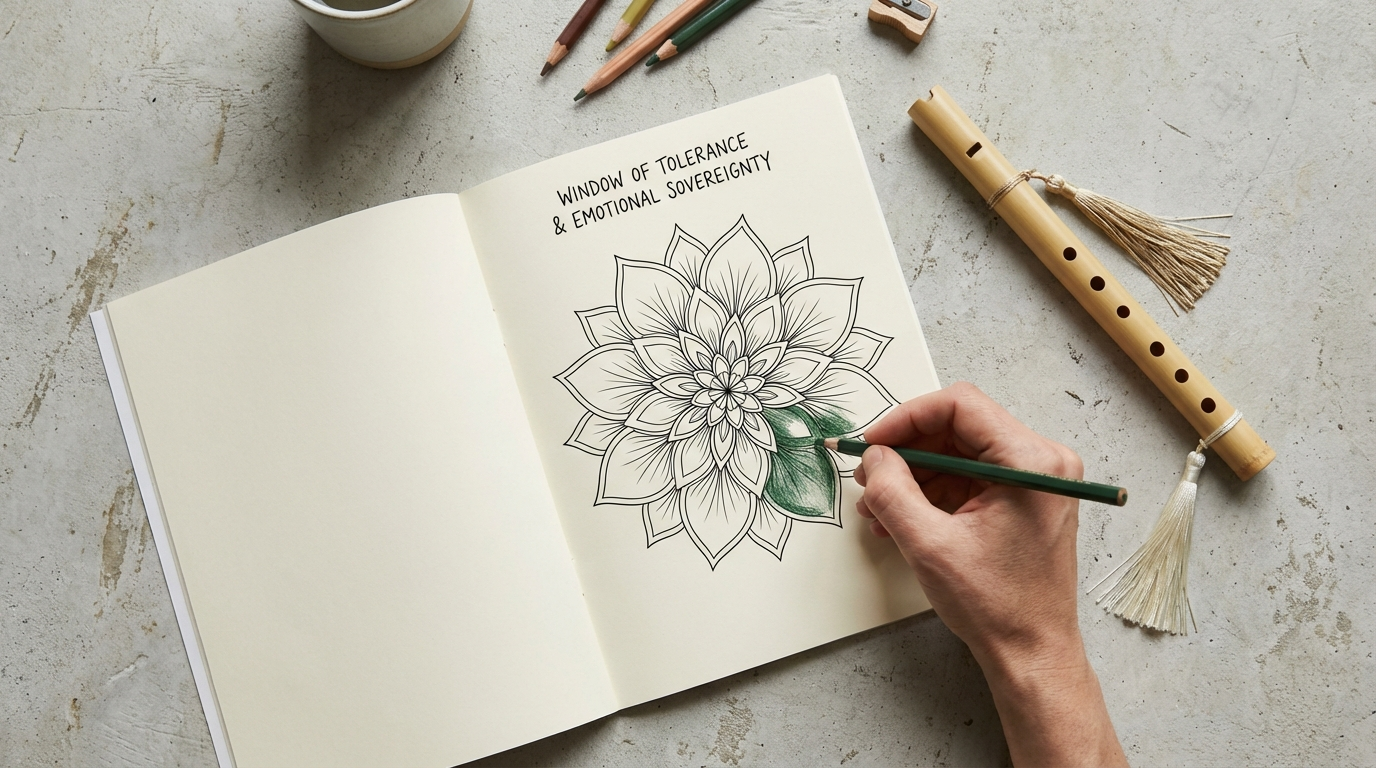
- The Power of Resonance: When my thoughts spiraled into a storm, I turned to the Daegeum. Research into 528Hz frequency suggests it can help reduce cortisol levels and promote a sense of calm. This frequency reaches the deep parts of the brain where language and logic cannot go. Focusing on the vibration of the sound allowed me to anchor myself in the physical world. This resonance is a key tool in reclaiming me, as it clears the static and leaves room for my own vibration to return.
- Active Meditation: Using the Speak Love to Yourself coloring book became a grounding ritual that demanded my full attention. This puts the brain into a flow state, where cognitive energy moves away from the worry centers and into the hands. This simple action forces a transition from abstract, looping thoughts to concrete, physical reality. It is a way of reclaiming my focus from the past and placing it firmly in the now.
- Visualizing the Release: I started writing my looping thoughts on paper to physically remove them from my internal space. Once they were on the page, they were no longer part of me. Then, while listening to the flute, I would visualize those thoughts as leaves floating down a river. I learned that I dont have to jump into the water to catch them; I can simply sit on the bank and watch them drift out of sight.
Closing: The Sacred Silence of Reclaiming Me
Reclaiming me is not about finding all the answers to the chaos you lived through. It is about reaching a point where the questions no longer have power over your peace. For years, your mind was a battlefield where you fought to justify your existence and your reality. Overthinking was your primary weapon, but in the safety of your new life, that weapon has become a heavy burden that keeps you anchored to the past.
The process of silencing the noise takes time because your nervous system has to learn that silence is not a sign of an approaching storm, but a sanctuary of your own making. Every time you choose to listen to a 528Hz frequency instead of an old argument in your head, you are voting for your own freedom. Every time you pick up a coloring pencil and focus on the present, you are telling your past that it no longer owns your attention.
Furthermore, you deserve a mind that is a garden, not a courtroom. Reclaiming me means realizing that my mind is finally allowed to rest because the war is over, and I am the one who won. By returning to my senses through sound and intentional action, I can finally hear my own true voice again—the one that was there all along, waiting for the noise to stop.
Take a deep breath and let the loop go. You are here. You are safe. You are yours again.
Reclaiming me involves moving out of the freeze response, a biological state described in Polyvagal Theory. This is why I use the 528Hz frequency to signal safety to the nervous system.


Leave a Reply